Climate, allergies and plants – an uncomfortable link
By Claudia Blaurock
I am personally affected: as someone with allergies, I now hardly ever get a break. What used to be clearly distinct seasons – spring, summer and a low-pollen period in winter – has now become a state of almost constant exposure.
The growing season has lengthened dramatically as a result of climate change. Winters cold enough to allow for a proper break from pollen have become rare. Instead, the first trees and shrubs now often start flowering as early as December, whilst autumn seems to drag on well into November. For allergy sufferers, this means one thing above all: constant stress.
This personal experience is not an isolated case, but is consistent with scientific findings.
Rising temperatures and increased CO₂ concentrations are causing plants to start flowering earlier, flower for longer and produce more pollen overall.
The traditional ‘pollen-free period’ is shrinking or disappearing altogether. At the same time, it is not only the duration but also the nature of the exposure that is changing: studies show that, under altered environmental conditions, pollen undergoes structural changes, becomes more fragile, releases allergenic particles more readily and possesses a higher inflammatory potential (Liu et al., 2022).
The structure of urban greening under scrutiny
The number of people affected is rising, as is the severity of their symptoms. Allergic conditions have been on the rise for years, particularly in urban areas. It is therefore no surprise that environmental health specialists are sounding the alarm and trying to protect their patients from the supposed causes. In Berlin, for example, the European Centre for Allergy Research Foundation (ECARF) recommends that certain tree species should no longer be planted at all. Wind-pollinated species are considered problematic, whilst insect-pollinated ones are regarded as significantly less harmful.
This logic is understandable, but it falls short. It reduces a complex interplay of climate, urban structure, vegetation and health to simple exclusion lists. But does it really make sense to rely strictly on lists of recommendations and completely ban birch, poplar, plane or alder trees? What effect would that actually have? Pollen can travel many kilometres. Plane tree pollen has even been detected at altitudes of over 6,000 metres. It inevitably follows that taking action at a local level achieves very little.
The work of Susanne Jochner-Oette (2018) shows that the allergenic potential of urban green spaces does not depend solely on the plant species. Rather, individual plant parameters and site conditions are decisive: age, vitality, pruning regime, water and nutrient supply, heat and drought stress, as well as air pollutants. A single, severely stressed tree can therefore be more allergenic than several healthy specimens of the same species.
Above all, however, the fixation on ‘problem species’ distracts from the real issue: the structure of our urban greenery. If one takes a serious look at the recommended low-allergen lists, it quickly becomes clear how severely they restrict the range of plants available. Only a few species remain – with the result that we end up with precisely what urban ecologists and landscape planners have been criticising for years: monocultures or highly standardised green spaces.
More diverse greenery promotes good health
Such monostructures are ecologically unstable, susceptible to diseases, pests and climate stress, and are sensitive to extreme events such as heat or drought. At the same time, they can generate very high local pollen concentrations – even when the species in question are supposedly low-allergen.
Jochner-Oette (2018) shows that homogeneous plantings, in particular, concentrate risk rather than spreading it. In contrast, diversity has a stabilising effect: species-rich, structurally diverse green spaces spread out flowering times, pollen types and exposure both temporally and spatially; they buffer against extreme conditions; promote healthy plant development; and reduce stress factors that can increase the allergenic potential of individual plants. Diversity is therefore not only an ecological goal, but also a health benefit.
And this is the crucial point: more green space – particularly diverse green space – has been shown to promote good health.
Large systematic reviews and meta-analyses show that people who live in green environments or spend time there regularly have lower overall mortality rates, are less likely to suffer from cardiovascular diseases, experience less stress and enjoy better mental health (Twohig-Bennett & Jones, 2018; Gianfredi et al., 2021).
These effects are well documented by studies. Vegetation absorbs particulate matter and air pollutants, lowers the ambient temperature, reduces heat stress and improves the microclimate – factors that play a key role, particularly in densely built-up cities.
Furthermore, studies show that spending time in green environments measurably lowers cortisol levels – the stress hormone which, in cases of chronic stress, affects the immune system and can exacerbate allergic reactions (Twohig-Bennett & Jones, 2018). Chronically elevated cortisol levels exacerbate inflammatory processes and can intensify allergic symptoms. If cortisol levels fall as a result of spending time in green spaces, this has a regulating effect on the immune system and can indirectly alleviate allergic symptoms.
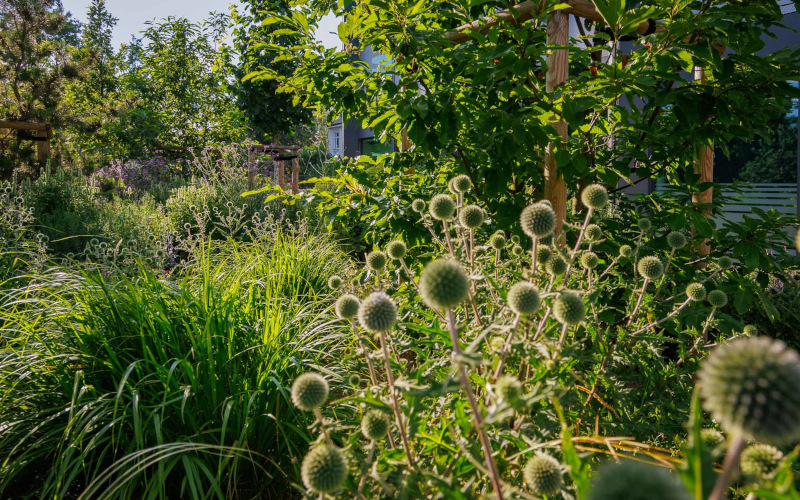
Green spaces are therefore not only a psychological feel-good factor, but also a biologically effective buffer against stress-induced allergies. Fine particulate matter, on the other hand, is regarded as a significant trigger of allergic symptoms. In this context, more greenery does not mean greater risk, but rather less strain.
The stress-reducing effect of diverse vegetation – evident in falling cortisol levels, lower blood pressure and a reduced heart rate – is a key mechanism through which urban greenery influences both general health and allergic conditions.
In short: trees and plants do us more good than harm – provided we plant wisely, with diversity and in a way suited to the location.
My conclusion
Let’s plant – boldly, diversely, comprehensively. The answer is not less greenery, but better greenery.
Monocultures do nothing to benefit health, biodiversity or the stability of urban ecosystems. Anyone who believes they can solve allergies through radical exclusion lists is tackling the symptoms rather than the causes.
Happy planting!
References:
- Jochner-Oette, S. (2018). The influence of individual-specific plant parameters and species composition on the allergenic potential of urban green spaces. Physical Geography / Landscape Ecology and Sustainable Ecosystem Development, Catholic University of Eichstätt-Ingolstadt; University of Granada.
- Twohig-Bennett, C., & Jones, A. (2018). The health benefits of the great outdoors: A systematic review and meta-analysis of greenspace exposure and health outcomes. Environmental Research, 166, 628–637. https://doi.org/10.1016/j.envres 2018.06.030
- Gianfredi, V., Buffoli, M., Rebecchi, A., et al. (2021). Association between urban green space and health: A systematic review of the literature. International Journal of Environmental Research and Public Health, 18(10), 5137. https://doi.org/ 10.3390/ijerph18105137
- Liu, S.-H., Kazemi, S., Karrer, G., et al. (2022). Influence of the environment on ragweed pollen and its sensitising capacity in a mouse model of allergic lung inflammation. Frontiers in Allergy, 3, 854038. https://doi.org/10.3389/falgy.2022, 854038
Further information on this topic
Author: Claudia Blaurock, landscape architect (bdla), Blaurock Landscape Architecture, Dresden, bdla specialist spokesperson on plant use. The text appeared in the bdla association journal “Landschaftsarchitekt:innen” 1/2026.
- Latitude: 0
- Longitude: 0