Healthy cities within ecological limits – a key priority for sustainable urban development
By Nicole Stauf and Dorothea Baltruks
How and where we live, how we get about, how we spend our leisure time, how we interact socially, the air we breathe and what we eat – these factors have a significant impact on our health and well-being. Health is shaped by our living environments and thus by the interplay of spatial, economic, social, climatic and ecological factors. Landscape architecture bears a central responsibility in designing urban living environments that promote health and are sustainable.
Stable climatic conditions, biodiversity, clean air and clean water, alongside other ecological systems, form the basis for a healthy life. This fundamental understanding is encapsulated in the concept of planetary health.
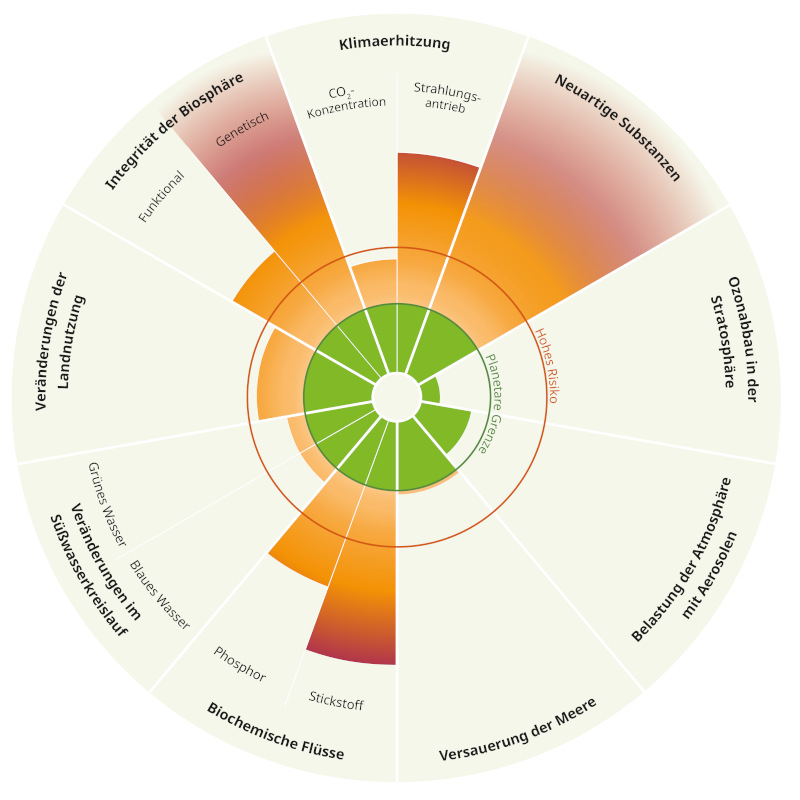
It is based on the nine planetary boundaries, which are essential for the stability and resilience of the Earth system and within which a safe operating space for humanity exists. As of 2025, seven of the nine planetary boundaries have already been exceeded (see figure below) – significantly reducing the safe operating space for societal development.
We are thus increasingly jeopardising the foundations of our existence and risking the collapse of ecosystems that were originally intact and resilient – with direct consequences for health, safety and quality of life, particularly in cities.
The concept of planetary health links these ecological limits to the political, social and economic systems that enable equity in health outcomes. Only those who can meet their basic needs and have access to good education, work and healthcare can lead a healthy and dignified life. Planetary boundaries provide the framework against which urban development must be guided in the long term.
Landscape architecture, in particular, operates at the interface between social environments and ecological systems and can make a significant contribution to giving planetary health a tangible spatial expression.
Cities as focal points and catalysts
The increasingly severe climate and environmental crises affect cities in a particular way and, consequently, more than two-thirds of the German population. Vulnerable groups are particularly affected, including children, older people, those with pre-existing conditions and socio-economically disadvantaged population groups, who are often disproportionately affected and, in some cases, face multiple burdens.
It should be emphasised that the direct and indirect health risks to our physical and mental well-being do not stem solely from extreme weather events.
It is also crucial how the planning and design of urban spaces, infrastructure, information and warning systems, as well as the health and care sectors, are prepared for challenges such as heatwaves, droughts, floods and storms, and how they provide protection for the population.
Cities are not only affected by climate and environmental crises; they themselves contribute significantly to the strain on ecosystems. The reasons for this include, amongst other things, the high energy and resource consumption associated with built infrastructure and transport, the resulting emissions of greenhouse gases and air pollutants, and the land use required for housing and infrastructure. Soil sealing and the loss of biodiversity are direct consequences of this trend.
At the same time, cities are the key arenas for action where the necessary transformation towards healthier, ecologically resilient and more sustainable living environments can be planned and implemented. Cities are thus both the focal point of the exceeding of planetary boundaries and a catalyst for processes of social transformation.
Policy frameworks for climate resilience and biodiversity
The policy framework for climate-resilient cities and the protection of public health is in place, although progress in its implementation varies greatly: The German Strategy for Adaptation to Climate Change, which sets out specific targets under the Federal Climate Adaptation Act (including for health and care as well as urban development), obliges the federal and state governments to systematically drive forward climate adaptation.
For cities, this means that politicians, administrators and specialist departments must systematically assess climate risks – such as heat stress and flooding – and embed climate adaptation as a planning objective in urban development.
The benefits that nature provides for human health are also emphasised in the National Biodiversity Strategy 2030. The requirement to integrate biodiversity conservation into urban and land-use plans also directly supports health objectives such as protection against heat, air pollution and noise, as well as the creation of attractive spaces for physical activity.
The European Nature Restoration Law also promotes health. Nature-based solutions are also intended to contribute to cooling in summer, protection against flooding and stress reduction. Quality of life will improve as a result of the new guidelines for green spaces.
This presents an opportunity for landscape architecture to actively combine the synergies of climate adaptation, health protection and environmental protection in urban design. In this way, it can help to protect and strengthen both public health and the health of ecosystems.
Planetary health at the heart of urban development and spatial planning
Many cities have recognised the challenges posed by climate change and are taking measures to adapt. New green spaces are being created, cool and shaded areas designated, and access to free drinking water in public spaces provided.
Whilst these measures are particularly important for short-term protection against heat, they are insufficient in the medium and long term. Given the complexity of urban spaces and ecological systems, a systemic understanding is a key prerequisite for healthy, sustainable and resilient urban development. Integrating planetary health into the guiding principles of urban development can help to make these interconnections more visible and enable effective, cross-sectoral action over the long term.
A wide range of approaches for promoting health and sustainability in cities already exists, including in the New Leipzig Charter and the White Paper on Urban Greenery. Specific measures include the application of the ‘sponge city’ concept, the strengthening of blue-green infrastructure, the use of climate-resilient vegetation, and the expansion of green spaces, vertical greening, green corridors and air corridors. Added to this are the development and application of circularity in planning and construction, and the promotion of active mobility through the expansion of cycle lanes and footpaths.
Public urban spaces are usually very limited, and conflicts of interest between societal, social, economic and ecological uses are inevitable. It is therefore essential to ensure equitable participation in order to provide everyone with equal access to liveable spaces and to increase social acceptance.
The State of Berlin’s Environmental Justice Atlas is a good example of how the interplay between socio-economic disadvantage, air pollution, noise and bioclimatic stress, as well as access to green spaces and open spaces, can be analysed. Ecological and social interests must not be pitted against one another, but should instead be regarded, as in this example, as interacting dimensions of justice.
A win-win-win situation for health, the environment and the climate
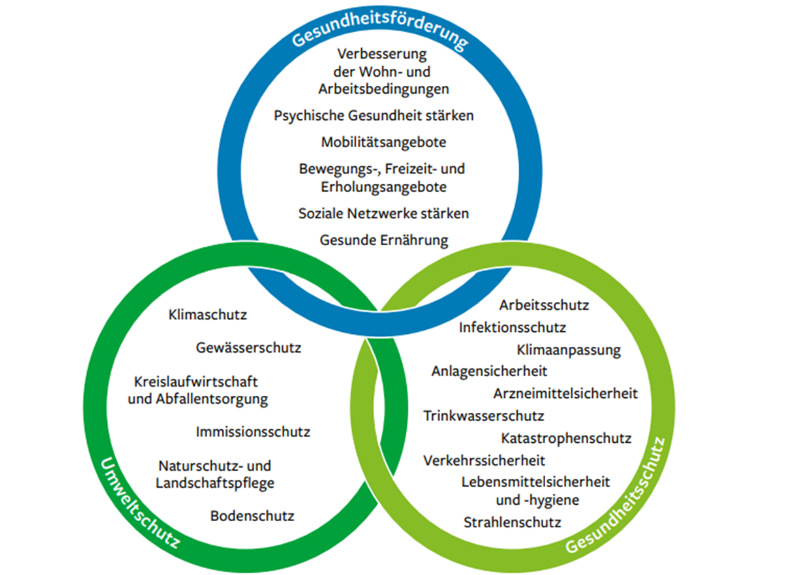
Health protection, health promotion and environmental protection can be implemented in an integrated manner and achieve synergistic effects (see figure below). In particular, the design of urban green spaces can contribute to health protection and health promotion in a variety of ways. The health benefits are considerable and well-documented by scientific evidence – including with regard to physical health.
A large-scale survey conducted over 19 years in 6,800 locations in Australia, Brazil, Canada, Chile, New Zealand, South Korea and Thailand over a 19-year period showed that access to urban green spaces helps to reduce hospital admissions due to various mental health conditions such as psychoses, substance use disorders and mood disorders.
Furthermore, taking biodiversity into account when designing urban green spaces strengthens the ecological and climatic resilience of urban areas and contributes in the long term to the stabilisation of health-related ecosystem services. An economic analysis that goes beyond a cost-benefit analysis for individual sectors – and takes into account, for example, the economic savings resulting from a reduced burden of disease, lower healthcare costs and reduced absenteeism from work due to investments in green spaces or cycling infrastructure – also provides strong arguments. These synergies and co-benefits are still not sufficiently recognised, either politically or socially, even though they could significantly increase the acceptance and effectiveness of measures.
Protecting and promoting health and well-being within planetary boundaries is therefore also a key task and opportunity for sustainable urban development. Shaping the landscape means making an important contribution to better health, ecological stability and social participation, and helping to shape resilient and sustainable urban development.
Bibliography:
- Planetary Boundaries Science (PBScience). 2025. Planetary Health Check 2025. Potsdam Institute for Climate Impact Research (PIK), Potsdam, Germany.
- Baltruks D, Gepp S, van de Pas R, Voss M, Wabnitz K (2022). Health within planetary boundaries. Unanswered questions for policymakers, scientists and health stakeholders. Policy Brief 01–2022. DOI: 10.5281/zenodo.6642685
- Ye T, Huang W, Xu Z, Xu R, Yu P, Wu Y et al. Greenness and hospital admissions for cause-specific mental disorders: a multi-country time series study. BMJ 2025; 391:e084618 doi:10.1136/bmj-2025-084618
Further information on this topic
Authors: Nicole Stauf, research assistant, Dorothea Baltruks, Director, Centre for Planetary Health Policy (CPHP), c/o KLUG – German Alliance on Climate Change and Health e.V., Berlin. The text appeared in the bdla association journal “Landschaftsarchitekt:innen” 1/2026.
- Latitude: 0
- Longitude: 0