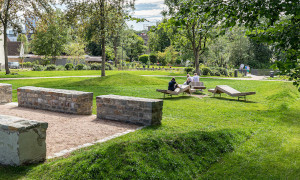
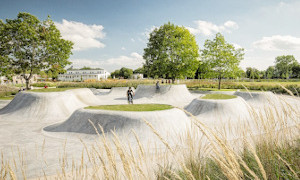
Gwendolyn Kusters, a landscape architect (bdla) and delegate of the Federal Chamber of Architects, and Thomas Haas from the bdla’s federal office, at the IFLA Europe Regional Conference and General Assembly, which took place in Brussels from 16 to 19 October 2025. The event was hosted by the Belgian Association of Landscape Architects (BALA).
Under the theme ‘NEW URBAN LANDSCAPES – regenerating cities, revealing new urban landscapes’, the focus was on innovative strategies for reinterpreting and repurposing urban open spaces – against a backdrop of climate justice, competing land-use demands and biodiversity loss. The conference was held at the Belgian architecture centre CIVA.
Thematically, the conference centred on two key planning approaches: climate-resilient adaptation of existing urban structures through land decompaction, site-specific planting schemes and green-blue infrastructure; and the reclamation of unused areas such as industrial sites, car parks, derelict and railway sites, or rooftops.

The event kicked off with excursions to Antwerp and Charleroi, where current projects in climate-friendly urban development were presented. In the afternoon, representatives from BALA, IFLA Europe and CIVA officially opened the conference. Dr Ursula Wieser Benedetti set the tone for the proceedings with her lecture ‘Invisible Federation of Landscape Architects?’, calling for greater societal focus on the achievements of landscape architecture. Simon De Muynck (Université Libre de Bruxelles) highlighted the shortcomings and potential of public open spaces in highly densified neighbourhoods. Guillaume Herr-Zekanowski (For Urban Passion FUP), in his presentation entitled ‘Designing Density’, demonstrated how redensification and high-quality open space design can be integrated. Jerome Kockerols (BMA Brussels) presented the Belgian ‘Bouwmeester’ model as an interface between politics, administration and planning. During the ensuing discussion, a municipal manual for public spaces in Brussels was presented – including guidelines on rainwater management, heat protection and nature-based design. Social aspects, such as conflicts over use arising from a scarcity of open spaces within Brussels’ federal administrative structure, were also discussed at length.
The second day of the conference began with guided tours of Brussels and continued with a keynote address by Dr Haris Piplas, who presented strategies for the planning reorientation of European cities in the face of the climate crisis. Diego Luna Quintanilla and Helène Rillaerts (SWECO) presented ‘Urban Green as a Driver for Regenerative Development’, outlining minimally invasive interventions for the climate-resilient transformation of open spaces. Examples included the OPEN Brussels project, which connects parks via green-blue infrastructure, and the participatory approach “Bruxelles plante / Brussel plant”. Roselyne de Lestrange (Brussels Environment) provided insights into the implementation of the EU Recovery Regulation in the host country. Kollektif Landscape and OMGEVING presented specific projects such as the conversion of a motorway section into a park strip in Kortrijk, the removal of impervious surfaces at Place Flagey, and the Rohan Climate Park in Prague. A keynote speech by Bas Smets (Harvard University) on circular urban regeneration rounded off the day.
As is tradition, the General Assembly began with the presentation of the IFLA Europe Award, which this year went to the European Network for Sustainable Cities and Communities, ICLEI. The prizes for the youth competition on the conference theme were also awarded: 22 projects from across Europe had been submitted, with the winners coming from the UK and Romania. In the PechaKucha session that followed, the member associations presented their projects. On behalf of Germany, Gwendolyn Kusters presented the transformation of a former marl pit in Hannover-Misburg into a nature-oriented recreational area with a swimming lake.
On Saturday morning, the delegates met behind closed doors to discuss administrative and financial matters. Elections to the Executive Board also took place. The outgoing President, Katerina Gkoltsiou, emphasised the importance of ongoing professional policy work at EU level. Newly elected to the Executive Board were Indra Purs (Latvia) as President, Christos Papachristou (Ireland) as General Secretary, Linus Frederiksson (Sweden) for communications, Paula Simoes (Portugal) for professional practice, and Madara Markova (Latvia) for training. In the afternoon, four workshops on ongoing EU projects took place.

Sunday was devoted to evaluating the workshop results and adopting the IFLA Europe resolution. In addition, the Bosnian-Herzegovinian association ALABiH was admitted as a provisional member and a Memorandum of Understanding was signed with the European Council of Interior Architects (ECIA). The next Regional Conference and General Assembly will take place in Riga from 2 to 6 September 2026.
The days in Brussels have impressively demonstrated how important the Regional Conference and General Assembly are as a forum for European landscape architecture. They bring together specialist knowledge, promote exchange and provide strategic impetus for the future of the profession.
- Latitude: 0
- Longitude: 0