Urban Trees as Habitats: Ecosystem Services, Biodiversity and Recommended Varieties
By Klaus Körber
Climate change is a fact; rising temperatures and falling groundwater levels are measurable – physics does not lie. The water supply during the growing season determines the success of plantings; this applies to all trees, including so-called ‘climate trees’, which are characterised by a higher tolerance to drought. In this context, the debate over whether a species is native or non-native is not productive when it comes to planting in our towns and villages.
However, climate change is also being used to divert attention from what, unfortunately, still happens far too often in horticultural practice: trees planted in holes that are too small, with many other planting errors, are subsequently neglected and die. Who is to blame? Climate change!
Yet optimising the planting process – from the planting hole right through to the comprehensive care of the trees over the years – is the real challenge of our time.
After all, if the basic conditions – from soil aeration and water supply right through to nutrient provision – cannot be guaranteed in the long term, this generally does not lead to success.
What is a ‘climate tree’?
Now the term ‘climate tree’ is doing the rounds amongst experts, and there are lists of recommended climate trees. What I keep noticing is that some tree users now only order trees that appear on these recommendation lists. Anything not on the list is simply not put out to tender in the first place. Tough luck! That’s not good. Because without proper care, I’ll kill off all trees, including honey locusts, elms and field maples. A ‘climate tree’ is an important building block, but it is just one building block on the path to success.
And: ‘climate tree’ is a flexible term. Every tree is a climate tree if it grows, produces oxygen, provides shade and stores carbon dioxide – regardless of whether it’s on a list or not. The hazel tree languishing by the roadside could be a wonderful ‘climate tree’ in a park or a woodland, and there are still some very beautiful beech, hornbeam, ash and birch trees. And yet we need lists to help us make decisions, to guide us and to spark ideas.
So: in future, we need great diversity in our plantings, and this will only be achieved if we make full use of the entire range of species available. After all, who’s to say that the honey locust will still be better than a rowan in 20 years’ time?
Selected tree species following the hot summers from 2003 to 2025
Selected legumes
Among the legumes, the Chinese pagoda tree (Styphnolobium), the cord tree and the honey locust (Gleditsia), along with their varieties, are particularly noteworthy for their heat tolerance and drought resistance, especially in poorer sites. Neither is always entirely low-maintenance during the juvenile stage or whilst the crown is developing, but the associated effort is certainly worthwhile. They are both good urban trees. In a direct comparison, the black locust is generally less robust, but it is still highly vigorous in open areas on light soils and has the potential to become invasive. It is increasingly prone to problems along roadsides in confined spaces and where there is salt contamination, but remains a suitable choice for planting.
Acer spp.
The field maple is the best native maple, faring comparatively well in numerous sites, including some with salt exposure such as motorways. It only suffers from brown leaves in extreme drought, but is almost always significantly more robust than the Norway maple. That said, the Norway maple and its varieties have, in some cases, tolerated heat and drought much better than expected on undisturbed soils with sufficient root space. In general, the Norway maple remains an important tree under good growing conditions and must under no circumstances be overlooked in the context of climate change. Its weaknesses in neglected and stressed urban street environments are well known and must be taken into account in planning. Mountain maples are thought to have developed massive problems with sooty bark disease, presumably as a reaction to the stress of recent years in dry areas, and can no longer be recommended where water is scarce. The French maple (Acer monspessulanum) is even more drought-tolerant than the field maple and is a good choice for smaller planting spaces.
Alnus spp.
Alnus x spaethii is one of the very best and fastest-growing tree species, and for this reason, Spaeth’s alder has now become firmly established. A densely growing shade tree that has proved itself well in both moist and dry sites throughout Europe. Trunk protection must be carried out conscientiously. The early pollen dispersal in January should not be overlooked here. Alnus cordata, the Italian alder, is somewhat underrated; it has also proved to be robust and has a slightly narrower growth habit, and should be planted more widely in future. Alders are able to thrive on poor soils through a symbiotic relationship with nitrogen-fixing microorganisms.
Celtis
The hackberry (Celtis australis) is found on warm, dry, rocky slopes in southern Europe and has now become an important street tree in the region. Its slightly lower frost hardiness only needs to be taken into account in planning for very cold regions. The trees are unremarkable in their growth during the early years; it takes a few years for them to develop character, and in fact they become increasingly beautiful with age. Celtis occidentalis, a more frost-hardy alternative from North America, is also available and performs very well even in heat and drought. Its growth habit is somewhat broader and more spreading; it is, if you like, a good shade tree for areas where a spreading habit might even be desirable. In its hardiness, Celtis is reminiscent of elms – and that’s a good thing!
Fraxinus spp.
The native ash trees, which have been spared from ash dieback, are highly tolerant of heat and drought. The same applies to Fraxinus ornus, Fraxinus pennsylvanica and Fraxinus americana and their cultivars, all of which display beautiful autumn colours and, incidentally, have not yet been affected by ash dieback under our climatic conditions. A remarkable tree is Fraxinus angustifolia ‘Raywood’. This southern European ash continues to impress with healthy growth and its characteristic dark red autumn colouration, even after the recent dry summers. In regions with high rainfall, this species can be susceptible to fungal disease; it should therefore not be planted there.
Ginkgo
(Ginkgo biloba) and the varieties we have tested here are proving to be very healthy, drought-tolerant and hardy. This tree simply must be included in this list. Most of the varieties in our trial site are male and therefore produce no troublesome fruit. There are some interesting growth forms, particularly when it comes to narrow crowns for confined street spaces. You simply need a little patience with the ginkgo; it usually takes a few years for it to provide adequate shade.
Liquidambar styraciflua
The sweetgum is currently a sought-after ‘trendy tree’, which has so far proved to be healthy, vigorous, with a sturdy trunk and harmonious growth in many locations. As a young plant, Liquidambar is somewhat sensitive to frost; trees from 18–20 STU are significantly hardier. A good water supply is important during the early stages of growth, as with adequate watering, the preferred acidic soil is no longer quite so crucial. Well-established trees then cope surprisingly well with heat and drought, though even here there is a point at which extreme water shortage can lead to the tree dying. The crowns are susceptible to windbreak; the same applies to wet snow, which can also cause crown damage. ‘Worplesdon’ is the main variety, characterised by reliable autumn colour, vigorous growth, no cork strips and abundant fruit production, particularly following a stressful year.
Ostrya carpinifolia
The hop beech is a close relative of the common hornbeam from the Caucasus, which, according to our observations in a direct comparison with the common hornbeam, tolerates heat better. However, under drought stress, vigorous fruiting can also be observed, which means that there is a point at which water shortage can lead to problems for this species too. A good complement to the hornbeam, which – when well cared for – can produce beautiful trees.
Tilia spp.
It is now well known that lime trees require sufficient growing space, are sensitive to road salt, and that their bark reacts to intense sunlight by suffering from summer sunscald, resulting in severe trunk damage. It is therefore essential that the bark is protected. There is a growing consensus that trunks should be painted at intervals of ten years or more. It is therefore not surprising that roadside lime trees have shown severe leaf damage and, in some cases, crown damage following the recent years of drought stress, in some instances accompanied by heavy leaf fall from July onwards. However, where there is sufficient growing space in well-nourished soil, there are numerous examples of lime trees that have fared well in recent years. The negative perception of the lime tree often relates to these stressed roadside specimens.
We must not forget: in our towns and cities, lime trees are by far the most important summer-flowering bee trees and are indispensable for ecological reasons alone. Generally speaking, the group of silver lime trees can be classified as slightly more heat-tolerant than other lime trees, although Tilia tomentosa can also struggle in the event of water shortage and, above all, requires regular watering during its early growth stages.
Ulmus
Word has (fortunately) got round amongst experts that there are elms which are not affected by elm dieback and which, moreover, can cope comparatively well with heat and drought. Alongside Gleditsia and Alnus x spaethii, elms are among the first species I mention when people ask me about so-called ‘climate-resilient trees’. This is because the group of resistant elms continues to impress, even after years of extreme conditions, with its enormous hardiness and vigour. Particularly noteworthy is the elm’s ability to continue growing rapidly after planting; transplant shock is extremely rare. The only aspect that requires close monitoring at the final location is the development of the crown. Some varieties tend to produce strong lateral branches, which are often relatively close together; timely thinning of the crown is then necessary and helps to counteract the impression of the tree looking aged. No tree species is entirely free of problems, but elms are undoubtedly worth planting more widely.
Please do not, however, forget to include the currently predominant trees – such as lime, Norway maple, oak and plane – in your planning. There are still many beautiful trees out there, and I cannot imagine our country without these ‘bread-and-butter trees of the cities’.
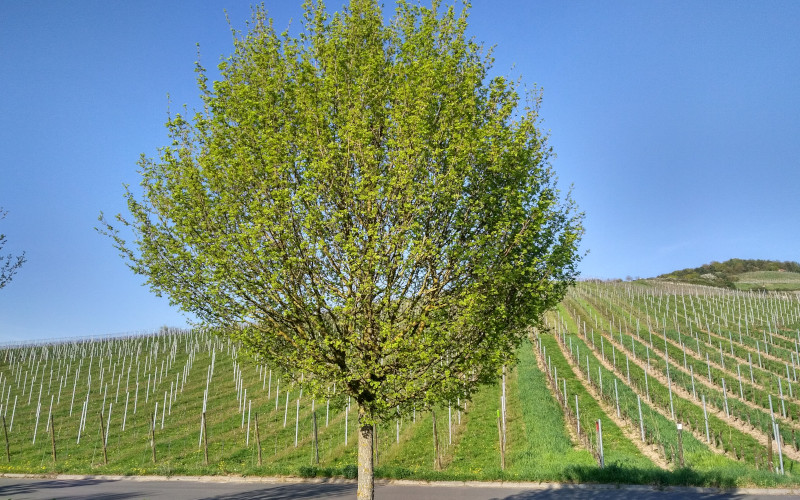
The field maple has so far proved to be very resilient to climate change, and the same applies to the varieties available on the market; it also copes very well with the effects of road salt.
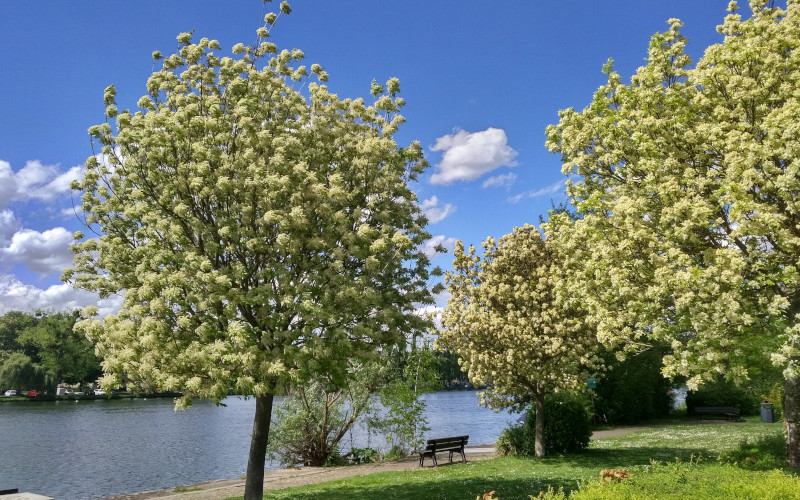
The manna ash is a common large shrub or small tree in many regions of Italy; so far, there has been no ash dieback, and it copes very well with heat and drought. Its white flowers in panicles in May and its reddish-purple autumn colour are striking.
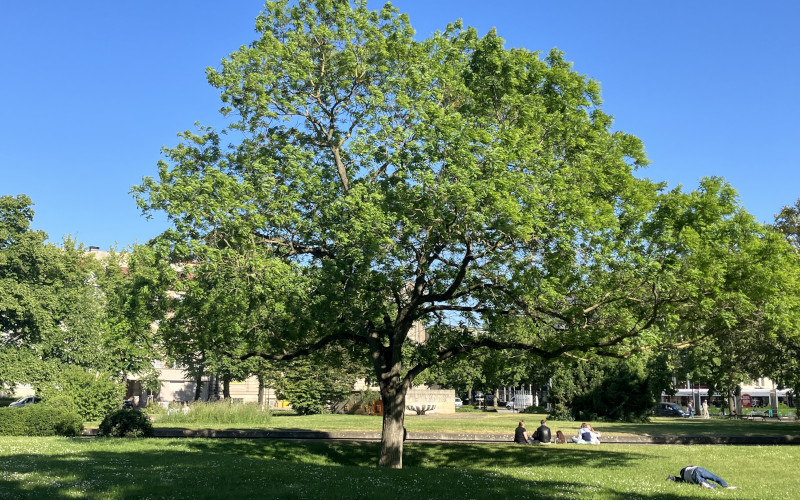
Styphnolobium ex Sophora japonica as a majestic park tree in Potsdam. It copes very well with heat and drought, provides an important late source of nectar for bees in July, requires support whilst young, always has a little deadwood, and is an important tree.
Further information on this topic
Author: Dipl. Ing. Agr. Univ Klaus Körber, Erlabrunn/Veitshöchheim.
The text appeared in the bdla association journal “Landschaftsarchitekt:innen” 3/2025.
- Latitude: 0
- Longitude: 0