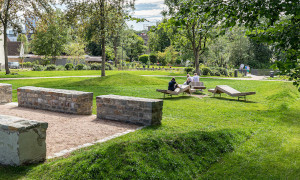
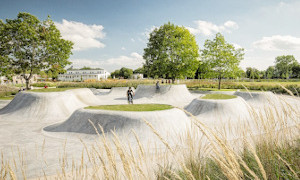
Just in time for the meteorological start of summer, on 1 June the Landscape Architecture degree programme focused on the climate and its impact on our health through a series of lectures, working groups and discussions. To mark Landscape Architecture Day, students, experts and guests from the fields of planning, public administration and medicine explored green spaces and open spaces, their impact on our health, and measures to adapt to climate change in our cities.
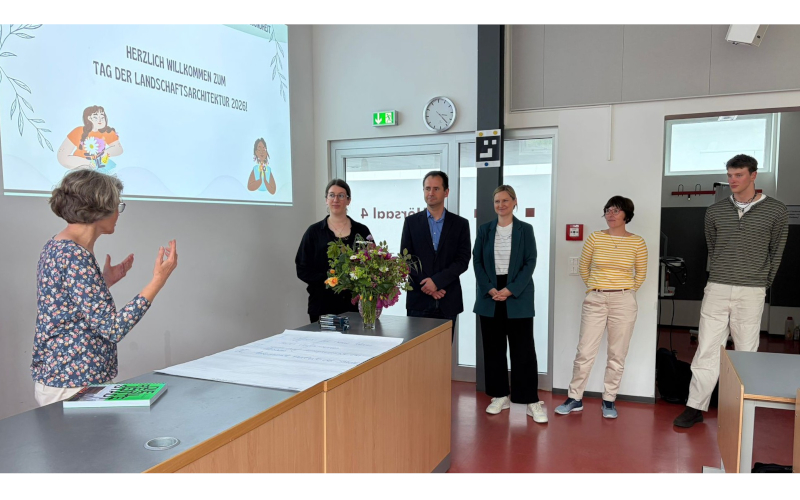
The event was held under the annual theme of ‘Climate Adaptation and Health’ set by the Association of German Landscape Architects (bdla), which also supported the day’s programme. All members of the executive committee of the Mecklenburg-Western Pomerania regional branch attended, as did other members.
Urban green spaces as protection against heat
Jacqueline Sambale and Bianca Schuster from Rostock’s Office for Environment and Climate Protection kicked
off the series of short presentations. Drawing on the Rostock Urban Climate Analysis, they explained the importance of green spaces and open spaces in providing protection from heat. Around 60 per cent of Rostock’s urban area consists of green spaces, yet even in the Hanseatic city there are areas of stress, such as the Kröpeliner Vorstadt or the city centre, which – due, amongst other things, to dense development and soil sealing – pose challenges during the summer months for vulnerable groups such as children, older people or those with pre-existing conditions.
Using specific projects as examples, the speakers illustrated how soil sealing reversal, intelligent rainwater harvesting and climate-adapted open-space design contribute to improving the urban climate. The challenges here, both in Rostock and in other cities, are that changes are predominantly being made to existing developments – meaning they cannot be implemented as optimal solutions on ‘greenfield sites’ – and the limited budget, particularly for the necessary maintenance of green spaces.
Neubrandenburg: between climate change and quality of life
Julia Manthe, responsible for urban development in Neubrandenburg (the ‘City of Four Gates’), then presented current measures and plans for climate adaptation. Among the many different topics discussed was the dredging of a fire-fighting pond, which entails high costs. Other topics included, amongst other things, seemingly smaller projects such as the redesign of the access roads to the New Cemetery following the construction of the bypass, the installation of water bottle refill stations in public facilities in the city centre, and shading concepts for the market square. She also provided insights into the city’s solar potential analysis, as well as planned developments around the town hall and on the station forecourt. Key takeaways were that climate adaptation tasks for urban development are diverse, that they are heavily dependent on the budget, and that all land must be managed sustainably. These represent challenges for Neubrandenburg; however, it became clear that the urban development department is strongly committed to tackling these challenges in the interests of the city’s residents.
Focus on the health consequences of climate change
Dr Thomas Jenning, a specialist in hygiene and environmental medicine at the Dietrich Bonhoeffer Clinic in Neubrandenburg, highlighted the impact of rising temperatures on the healthcare system. He pointed to the high number of heat-related deaths in Germany in recent years, which are already higher than the number of road traffic fatalities. Consequently, heat protection – for example, through the annual ‘Heat Action Days’ in June – is also a key focus for the medical associations. The Ministry of Health raises awareness of heat-related health protection through, amongst other things, guidance documents, specialist conferences and model heat protection plans. He himself has contributed to the LAGuS’s recommendations on heat protection in hospitals in Mecklenburg-Western Pomerania, taking climate change into account.
New challenges posed by climate-related pathogens, such as the West Nile virus, are of great significance. The presentation clearly demonstrated how important – and also how challenging – heat protection measures are, particularly in healthcare facilities, where sterility is of paramount importance and where, in addition to temperature, other climatic parameters such as humidity, air exchange rates and air flow are also significant.
Reducing thermal stress indoors and outdoors is essential, and landscape architecture measures are well-suited to this purpose. However, these could also lead to health problems if, for example, breeding grounds for disease-carrying insects develop in water bodies created for cooling purposes. Solutions must always be assessed on a case-by-case basis to avoid negative consequences. Collaboration between landscape architects and medical professionals is highly advisable.
Maggie’s Centres
The final presentation was given by Vincent Wanitschke, a fourth-semester landscape architecture student, on the Maggies Centres in England. The centres were conceived and developed by Maggie Keswick and her husband Charles Jencks whilst Maggie was battling cancer in the 1990s. Today, the more than 30 centres – featuring interesting architecture combined with high-quality, well-maintained outdoor spaces – offer a wide range of support for people living with cancer. The unique combination of medical care, architecture and landscape architecture enhances patients’ quality of life; these centres are exemplary models of health-promoting design.
Exchange in workshops
Following the keynote presentations, participants and speakers explored the topics covered in the talks in greater depth during workshops, as well as addressing issues relating to climate adaptation and health. The findings were then presented and discussed collectively. One central theme ran through the entire day: green spaces and open spaces are not merely design elements – they make an important contribution to health and social justice in our cities; however, from a health perspective, they must also be very precisely tailored to people, their time spent outdoors and their specific needs.
Conclusion
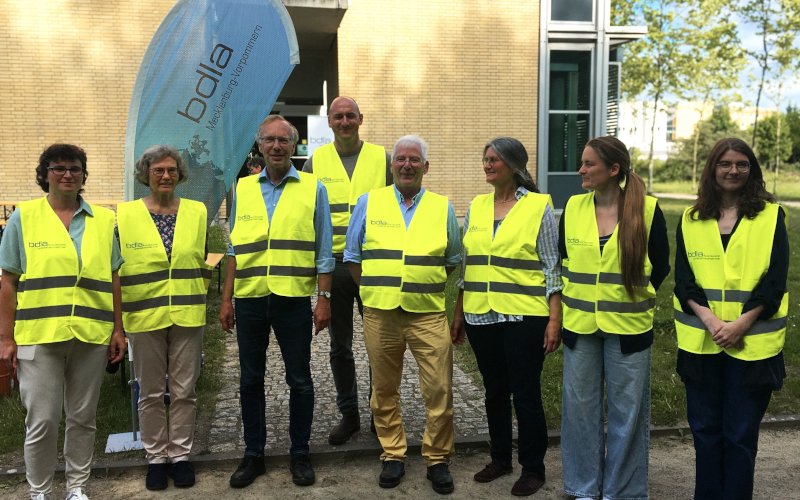
The idea for the theme day in collaboration with the bdla has enabled participants to get to know one another through discussions on current topics. As in previous years, Professor Mertens took the opportunity to ensure that fourth-semester students learn not only about specialist topics but also how to organise a conference. Although the topic and guests had been selected, the students had to take on the role of moderators, introduce the guests in the lecture theatre and chair the discussions and working group sessions. They also had to send out invitations by email and put up posters in advance, as well as organise the decorations, catering and, last but not least, tidy up afterwards. From an academic perspective, too, the day had been prepared since the start of the semester, including through articles from the association’s journal on the annual theme and other specialist literature. A particular highlight of the event was that the students engaged in direct, in-depth exchanges with the guests, particularly during the working group discussions. This closeness, and the opportunity to ask questions that might not otherwise be raised in a larger group, enriched the insights gained during the day. We succeeded in discussing this serious topic in a relaxed atmosphere, breaking down barriers with the professional experts and getting to know one another. The day concluded with a barbecue in the garden and good conversation, as well as the distribution of high-visibility vests bearing the bdla logo to members. We would like to extend our heartfelt thanks to all guests and participants for making the day such a success.
Martin Fröse, Elke Mertens
- Latitude: 0
- Longitude: 0