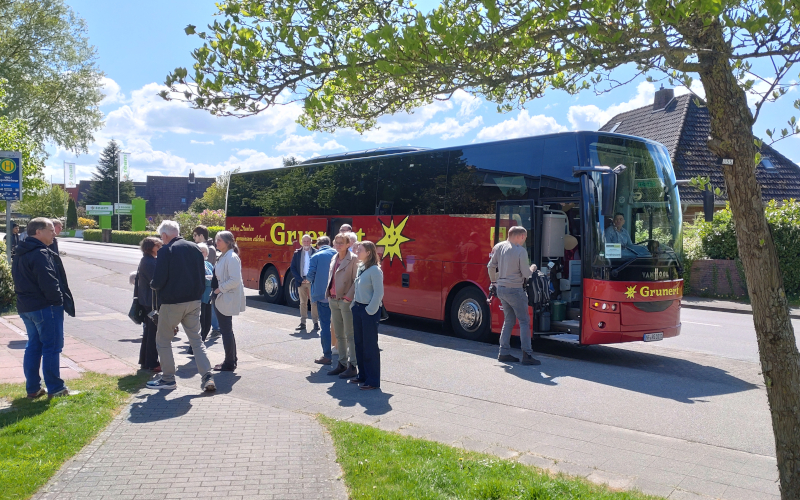
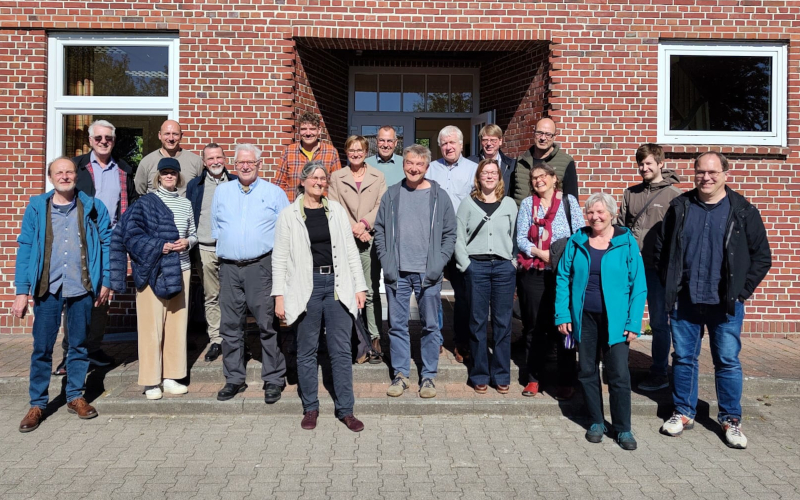
On Friday 8 May, the Nordlichter summer party took place as part of a coach tour through North Frisia in the Husum area. Twenty participants from the northern bdla federal states – namely the regional associations of Hamburg, Mecklenburg-Western Pomerania, Lower Saxony & Bremen, and Schleswig-Holstein – were on board.

Our bdla ‘Northern Light’, Michael Mäurer, has put together a fascinating programme and, as a true local veteran, has provided us with interesting insights thanks to his excellent contacts. Drawing on a wealth of background knowledge, he acted as our guide at each stop and throughout the journey. A wide variety of local stakeholders – biologists, mayors and conservationists – opened their doors to us, told us about their work at the intersection of wind energy, renewable energy, tourism, health and nature conservation, and engaged with us openly and critically.
Start:
BioConsult SH – Managing Director Dr Thilo Liesenjohann spoke about the company’s development and the evolution of its remit since the 1990s in the field of ecological research and consultancy. Using specific video examples, he presented current methods for assessing the risks posed by wind turbines based on existing data. The collision risk analysis was fascinating, as was the highly interesting technology for collision avoidance in relation to bird strikes. This involves the use of traditional habitat mapping combined with high-tech equipment from the defence industry, right through to the use of AI for the real-time early detection of bird species, in order, for example, to decide whether and how ‘wind turbines’ (as everyone calls them here) should be adjusted or switched off.
In collaboration with farmers – on a voluntary basis and successfully despite conflicting interests – long-term monitoring programmes are being carried out to develop a land-use management strategy that minimises the risks of bird strikes whilst maximising the yield of the wind turbines.
We also gained an insight into satellite-based whale counts and the early detection of sandstorms in Egypt.
Closing remarks: ‘You get a sense of what the birdwatchers get up to otherwise.’
Continuing through the marshland:
We then travelled by bus through the countryside, dotted with numerous wind turbines, to the village of Reußenköge, a marshland landscape created by the construction of dykes. On the way, we passed ‘Kuddel Wind’, the region’s first wind turbine, which was built in 1983 by wind power pioneer Karl-Heinz Hansen with a rated output of 55 kW. By way of comparison: wind turbines built today have a capacity of 3.5 to 7 mW – around 100 times that of the original.
There is a community-owned wind farm with 90 wind turbines.
At the first stop: Reußenköge Wind Farm
In the ‘Koogshalle’ in the village of Reußenköge – the ‘model village with a pioneering spirit’ – we were welcomed by Mayor Dirk Albrecht (who is also managing director of the Reußenköge community-owned wind farm), who gave a brief overview of the village:
- Approx. 45 km², of which 10 km² is ‘nature’, the rest being agricultural land.
- Approx. 90 third-generation wind turbines, 340 inhabitants,
- just under 8 inhabitants per km² and 4 inhabitants per wind turbine -
1,000,000,000 kW/year output
Mr Albrecht reported on the widespread consensus amongst residents regarding the wind turbines, which is undoubtedly linked to the economic benefits. Unlike those merely managing shortages, politicians here are able to turn visions into reality.
Using examples, legal regulations, the obstacles they present and their links to ‘big politics’ were outlined. The important and positive cooperation between local politicians, the agricultural sector and biologists (see our first stop) was also acknowledged. ‘We’ve grown up together.’
Current energy policy was critically examined, explicitly regardless of party affiliations.
Over coffee and cake, we took the following quotes with us as we continued on our way:
‘The wind – it’s dreadful!’ – only the newcomers say that here.
“You could get dead tired in the shadow of the turbines.”
“Every car is louder.” “It was the absence
of envy and hatred that helped us.”
Conclusion: The ‘That’s just the way it is!’ process, through which one learns, takes place here.
At the scene of the action 2: Gotteskoogsee Nature Reserve
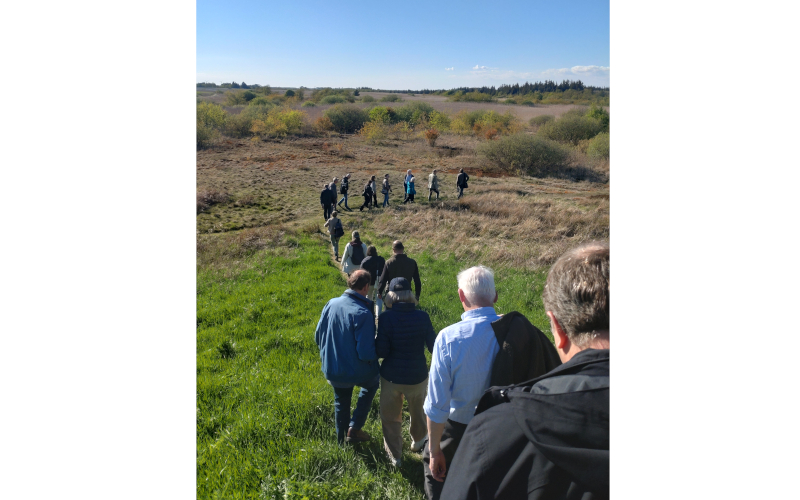
BUND Nordfriesland – Carl-Heinz Christiansen, a representative from the Energy Transition Working Group and responsible for statements on wind energy development, welcomed us to the Gotteskoogsee Nature Reserve, the former ‘Wiedingharde and Gotteskoog’ Special Area of Conservation (SAC), a largely inaccessible landscape, also formed by embankment works, which is equally a bird sanctuary, a Habitats Directive (FFH) site and a network of biotopes.
Mr Christiansen described to us the history and development of the landscape from the first ‘Mandränke’ – the great flood of 1362 – to the present day, whilst casting a critical eye on the future with regard to wind energy development. For BUND Nordfriesland, there is no alternative to an energy transition that is compatible with nature.
The former ‘Wiedingharde and Gotteskoog’ Special Area of Conservation (SAC), as one of the last large areas free of wind turbines in the vast marsh landscape, is currently at risk of losing its original character in terms of the landscape. We were able to experience the technical explanations for ourselves in a striking way from ‘Richie Hill’ (named after Richhard von Weizäcker), not to mention its importance for resting and migratory birds.
However, at this site there are particularly acute conflicts of interest involving climate protection and the energy transition, as well as nature conservation and the cultural landscape.
BUND hopes that no negative precedent will be set here.
At the scene of the action 3: Bosbüll
Mayor Ingo Böhm spoke very personally and openly about the energy transition in the municipality of Bosbüll, with its 270 residents. It began as a very labourious process of persuasion, involving going door-to-door, but ultimately led to the success of transforming the municipality from the ‘poorest’ to the most financially sound district in Schleswig-Holstein. This required great perseverance over a long planning period of 17 years, which was needed for the projects here. Currently, a wind farm spanning three villages (Bosbüll, Holm and Uphusen) and 65 hectares of solar parks are in the planning stage.
To make progress, the approach was sometimes simply: ‘That’s just the way it is!’
The municipality is pursuing a holistic approach known as ‘Optinetz’, a funding project aimed at optimising the entire system, which is supported by the Fraunhofer Institute and encompasses wind and solar energy, biogas and water electrolysis, right through to hydrogen mobility and district heating.
Local politicians know they cannot save the world. Current energy policy is also viewed here as a step backwards.
In conclusion, Mayor Böhm expressly extended an invitation to anyone interested to join a personal guided tour. Many thanks!
• © Daniel Tams
• © Daniel Tams
• © Daniel Tams
• © Daniel Tams
In conclusion
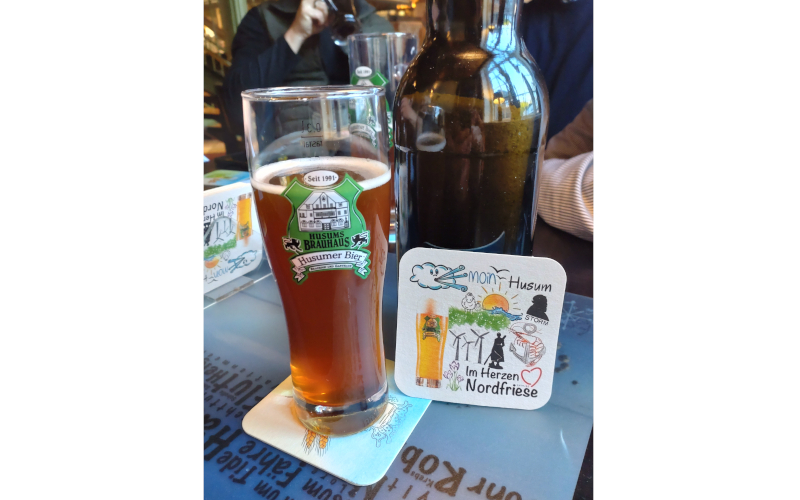
To round off our highly interesting excursion, we met in the evening at ‘Husums Brauhaus’, where we first continued our stimulating technical discussions. Surrounded by very friendly colleagues, the pleasant and personal exchanges then – as always! – rounded off our ‘Nordlicht’ summer party.
Report by ‘Nordlicht’ Bernd Groth
- Latitude: 0
- Longitude: 0