On 14 and 15 November, the Malenter Runde organised and celebrated its 40th anniversary. The theme ‘Back to the Future’ served as the central theme running through the event.

In keeping with tradition, Angelika Jacobs set the tone for the discussion with her atmospheric and thoughtful reflections on the future. Is the future being portrayed incorrectly? Was it better in the past? Not least for the sake of future generations, we need an understanding of the present in order to make the future possible. After all, the future is what we shape today. The future is a mindset, she concluded.
The team of moderators, Steffi Werhahn and Bernward Benedikt Jansen, guided the conference programme onwards. Interaction and discussion were encouraged right from the start, as topics relating to the future of our profession were explored in small groups and subsequently presented to the panel.
Prof. Henrik Schultz from Osnabrück University of Applied Sciences delivered a fascinating opening lecture on the topic of spatial images, a complementary tool in land-use planning. Using examples such as ‘The Green Fingers of Osnabrück’ and the ‘Rheinliebe IBA Basel’ project with Station C23 and rabe landschaften, he demonstrated that spatial visions can give rise to guiding principles that enjoy the widest possible acceptance amongst stakeholders and participants.
After lunch, Stephan Lenzen, President of the bdla (whose visit was particularly welcomed by the Schleswig-Holstein Regional Association), kicked off the afternoon with a plea for landscape architects to be vigorous and optimistic. This was to be discussed further during the concluding panel discussion.
Dr Andreas Villwock from the Helmholz Centre took a factual look at the future with the participants. His figures show that the climate is predictable for the next 20 years – the necessary course we set today will only become apparent from around 2045 onwards. Possible climate scenarios calculated today will therefore only have a significant impact after a considerable delay, for better or for worse.
Claudia Blaurock gave a vivid and engaging account, citing as an example a soil restoration project in a Dresden school playground, in which parents were actively involved and, through persuasion, became tree donors. In doing so, she raised, amongst other things, the point that one of the challenges of planning lies in planting for a future that we do not yet know. She never tires of reminding us how important a sound knowledge of plants is for our profession. And her plea, wherever possible: preserve old trees!
Moritz Möllers presented recent example projects from his Hamburg-based practice, Bruun & Möllers, including the Eichtalpark in Hamburg-Wandsbek and the Platz der Luftbrücke in Berlin. The complex drainage planning in this Berlin urban space has once again sparked discussion about tree swales and raised the question of how landscape architects position themselves at the interface with drainage planning.
First with a sporting warm-up under the watchful eye of Axel Fichtner, then accompanied by the wonderful music of the Jesse Grell Trio, the evening drew to a cosy close at the Uwe Seeler Football Park.

Saturday morning began with the balancing act between too much and too little water. Sandra Mörschel gave an informative presentation on the ‘Schleswig-Holstein macht sich wasserstark’ initiative, which was launched in response to the events in the Ahr Valley. According to Ms Mörschel, Cologne and Hamburg are currently leading the way in the creation of heavy rainfall maps, which classify and display the level of risk associated with heavy rainfall events on a plot-by-plot basis. Ms Mörschel also presented state-led campaigns designed to alert private property owners to the risks of heavy rainfall and flooding.
This was followed by a very impressive presentation by Luc Knödler, who illustrated the concepts of agroforestry and Keyline Design using specific projects and their implementation. How can agriculture cope with both too much and too little water at the same time? How can soil erosion be counteracted whilst maintaining a focus on yield profitability? How can water be ‘stored’ in agriculture and made available for later use in the field? This is where so-called Keyline Design projects come in, which aim to advise farmers on creating a climate-resilient cultural landscape. For a more in-depth introduction: just one day after the Malente Round Table, ZDF broadcast the following report on this topic:
Climate Change and Water – Solutions to Extreme Weather

In the concluding panel discussion, which the team of moderators Steffi Werhahn and Bernward Benedikt Jansen opened with controversial propositions, one seat was always kept vacant for the audience in accordance with the ‘fishbowl’ method, and the state of our profession was discussed very critically and assertively. It became clear that we need landscape architects who are vocal and outspoken in order to do justice to a field of work that is becoming no less complex. ‘Be louder!’ is just one call to action for our profession… to become more political… to be able to offer ‘low-tech’ solutions from time to time… to place greater emphasis on plants as a distinguishing feature from other disciplines and thus strengthen training in this area… to return to craftsmanship… operate in a way that transcends disciplinary boundaries … make the profession ‘sexier’ through higher wages … become aware of our core competencies, namely thinking in terms of dynamic processes and understanding the genius loci within a coordinate system … in short: Many interesting aspects were touched upon, which the participants were able to take with them on their journey home. And now it’s time to weave a little of the spirit of Malente into everyday life!

Once the talks and the discussion session had finished, everyone present was invited to visit the Malente spa gardens. We were very fortunate that Ms Julia Freese, chair of the ‘Friends of the Spa Gardens’ association, gave us a guided tour of the Malente spa gardens.

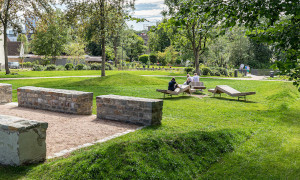
Amidst clear air and rays of sunshine breaking through the clouds, Ms Freese gave an inspiring account of the park’s decades-long history – a park that came into being solely because, for a place to be recognised as a spa town, a spa park is simply a must, alongside the sewerage system. Karl Plomin, a Hamburg-based landscape architect, designed it in close collaboration with architect Peter Arp. Towards the end of the 20th century, the spa park fell into disrepair due to a lack of maintenance and funding, and it was only thanks to the growing commitment of the Friends of the Spa Park in 2000 that the park was redeveloped and listed as a protected monument in 2004. Ms Julia Freese led a tour through the topographically varied park and, with great passion and attention to detail, spoke about cherry groves, footbridge structures, research into exposed aggregate concrete slab manufacturers and sources for specific rhododendron varieties, tropical exuberance in a temperate climate, and the safety instruction – and compromise – that gardeners must wear life jackets when working on footbridges over the Schwentine.

• © Jansen / König / Tams

• © Jansen / König / Tams

• © Jansen / König / Tams

• © Jansen / König / Tams

• © Jansen / König / Tams

• © Jansen / König / Tams

• © Jansen / König / Tams

• © Jansen / König / Tams

• © Jansen / König / Tams

• © Jansen / König / Tams
A big thank you goes to our supporters and sponsors of this year’s 40th Malenter Runde: ACO, Bruns Nursery, 4K Kommunalbedarf, Focus Lighting, Lorenz von Ehren Nursery, Runge and the Schleswig-Holstein Chamber of Architects and Engineers.
Report: Kerstin König

- Latitude: 0
- Longitude: 0